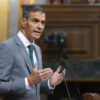
Iran has appointed a new Supreme Leader. Mojtaba Khamenei, the second son of Ayatollah Ali Khamenei, has been chosen by the Assembly of Experts to succeed his father, who was killed on the opening day of the Israeli-American strikes on 28 February.
The official announcement was made yesterday.
At 56, Mojtaba had long been mentioned among potential successors, alongside former parliamentary speaker Ali Larijani.
His appointment, however, breaks with several expectations surrounding the post. He has never held elected office and does not sit at the top of Iran’s clerical hierarchy.
His rapid elevation during wartime also instantly makes him one of the most visible targets in the conflict.
A wartime succession
Relatively little known internationally, Mojtaba Khamenei has built his influence largely behind the scenes and is widely considered closely aligned with the Islamic Revolutionary Guard Corps, the backbone of Iran’s security apparatus.
Analysts interpret his appointment as a signal of continuity and defiance from Tehran as the conflict enters its tenth day.
The weekend saw heavy bombardments across the Iranian capital. Smoke from burning oil facilities hung over Tehran, while strikes continued on military and industrial sites elsewhere in the country.
Iranian retaliation has targeted Israeli and U.S. military assets across the region, including installations in Gulf states. The United Arab Emirates denied involvement in retaliatory operations against Iran.
Meanwhile, Israel continued operations in Lebanon, striking a hotel in Beirut that it said hosted Iranian and Hezbollah personnel.
Regional escalation
The human toll continues to mount. Thousands have reportedly been killed in Iran, hundreds in Lebanon and dozens in Israel, with sporadic casualties elsewhere across the region.
The United States confirmed a seventh fatality among its personnel, following the return of the bodies of six others earlier this week.
Diplomatic contacts have intensified in parallel with the military escalation. European and U.S. leaders have been in constant consultation, with discussions involving representatives from the United Kingdom, France, Germany and Italy.
Italian Prime Minister Giorgia Meloni has been particularly active in these exchanges.
Civilian casualties are also under growing scrutiny. On 28 February, a girls’ elementary school in Minab was destroyed in a strike that killed a significant number of civilians. Preliminary investigations suggest the missile originated from a U.S. strike targeting a nearby Iranian naval facility.
Global repercussions
Beyond the battlefield, the conflict is already reshaping global markets.
Oil prices have surged to around $100 per barrel, reflecting fears of prolonged instability in the Gulf and potential disruption to shipping routes and energy infrastructure.
Energy analysts caution that prices could retreat if military operations stabilise the situation, though uncertainty remains high.
The war’s portrayal in some U.S. media and social media campaigns has also sparked criticism, with observers accusing parts of the public debate of trivialising the scale of civilian suffering.
Religious leaders and international organisations have called for restraint, dialogue and renewed diplomatic efforts.
For Iran, however, the immediate reality is a leadership transition unfolding under fire. Mojtaba Khamenei assumes power at a moment when the country faces one of the most direct military confrontations in its modern history.


Related posts
by Editorial Staff | 19 October 2026
One Europe, One Market Progress Review
by Mario Mauro | 09 October 2026
Russia’s Evolving Strategy: From Hybrid Pressure to Battlefield Adaptation